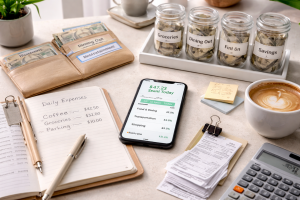
Overspending is one of the most common financial problems people face, regardless of income level. Many people assume that spending issues are caused by low income, but in reality, overspending is often the result of habits, lack of awareness, and poor daily control.
It does not happen in one big purchase. It happens through small, repeated decisions made every day. A coffee here, a quick online purchase there, or an unplanned expense can slowly drain your money without you realizing it.
The solution is not extreme budgeting or cutting out everything you enjoy. The real solution is building a simple and practical daily system that helps you stay aware and in control of your spending at all times.
Why Overspending Happens in Daily Life
To fix overspending, you need to understand why it happens. Most people do not overspend because they want to. They overspend because they are not paying attention to their financial behavior in real time.
One of the biggest reasons is the lack of tracking. When you do not track your expenses, it becomes simple to underestimate how much you are actually spending. If you want to understand this better, you should read complete guide to tracking daily expenses for better money management.
Another major reason is emotional spending. Stress, boredom, or the desire to reward themselves often drives people to spend money. These decisions are usually impulsive and not based on real needs. A deeper explanation of these behaviors can be found in emotional spending triggers and how to control them.
Digital payments also make overspending easier. Using cards or mobile payments makes spending feel less impactful than using cash. This creates a disconnect between spending and awareness.
Finally, many people simply do not have a clear system. Without a structure, spending becomes random and uncontrolled.
The Daily Control System That Actually Works
Instead of trying to change everything at once, you should focus on building a simple daily system. This system is designed to help you stay aware, make better decisions, and gradually improve your financial habits.
Step One: Set a Realistic Daily Spending Limit
The first step is to define how much you can spend each day. This makes your financial control immediate and practical.
Start by calculating your monthly disposable income. This is the money left after paying for essential expenses like rent, bills, and groceries.
Divide that amount by the number of days in the month. This gives you a daily spending limit.
For example, if you have 300 dollars available for flexible spending, your daily limit would be around 10 dollars.
This approach is simple but powerful because it helps you make decisions in real time instead of waiting until the end of the month.
Step Two: Track Every Expense Without Exception
Tracking is the foundation of financial control. If you do not track your spending, you cannot manage it.
Write down every expense, no matter how small. Even minor purchases like snacks or small online payments should be included.
You can use a notebook, a notes app, or a simple spreadsheet. The method does not matter as much as consistency.
Tracking helps you see patterns in your behavior. It also makes you more conscious of your spending decisions.
Many people realize that they are overspending only after they start tracking consistently. If you want a structured approach, refer to my simple way to track cash and card spending.
Step Three: Apply the 24-Hour Rule for Non-Essential Spending
Impulse purchases are one of the biggest causes of overspending. To control these urges, you should apply a simple rule.
Whenever you want to buy something that is not essential, wait for 24 hours before making the decision.
This delay gives you time to think logically instead of emotionally. Often, you will realize that the purchase is not necessary.
This practice can drastically cut down on wasteful spending over time.
Step Four: Separate Needs and Wants Clearly
One of the simplest ways to control spending is to classify every expense before making it.
Needs are essential for daily living. These include food, transportation, and basic utilities.
Wants are optional. These include entertainment, dining out, and non-essential shopping.
Before spending money, ask yourself whether it is a need or a want. This small pause can prevent many unnecessary purchases.
This habit becomes even more effective when combined with a structured budgeting approach like the one explained in personal budgeting tips for everyday financial control.
Step Five: Review Your Spending Every Day
Daily review is what turns this system into a long-term habit.
At the end of each day, take a few minutes to look at your spending. Ask yourself three simple questions.
Did I stay within my daily limit
Were all my expenses necessary
What can I improve tomorrow
This daily reflection builds awareness and helps you improve gradually.
Real Life Example of the System in Action
Consider a person earning 1200 dollars per month. After essential expenses, they have 300 dollars left for flexible spending.
They set a daily limit of 10 dollars.
On the first day, they spent 5 dollars on lunch, 3 dollars on snacks, and 12 dollars on an online purchase. This brings their total to 20 dollars, which is double their limit.
After applying the system, they start tracking every expense and use the 24-hour rule for non-essential purchases. They begin separating needs and wants before spending.
Within a few days, their daily spending drops to 8 to 10 dollars. They save more than $100 by the end of the month without having to adjust their income.
This shows how small daily changes can lead to significant financial improvement.
Common Mistakes That Keep People Stuck
Even with a system, some mistakes can prevent progress.
One common mistake is ignoring small expenses. People often think small purchases are not relevant, but they add up quickly over time.
Another mistake is inconsistency. Tracking for a few days and then stopping breaks the system.
Setting unrealistic limits is also a problem. If your limit is too strict, you are more likely to give up.
Emotional spending is another major issue. Without addressing it, even the best system can fail. You can learn more about controlling such behavior by understanding the psychology of spending and how to control it.
How This System Builds Long-Term Financial Stability
The purpose of this system is not just to stop overspending. It is to build habits that improve your financial future.
When you control your daily spending, you naturally start saving more money. This creates a foundation for financial stability.
You also become more aware of your financial decisions. This awareness helps you avoid debt and manage your income more effectively.
Over time, these small habits lead to bigger changes. You start planning better, saving consistently, and making smarter financial choices.
If you want to strengthen this further, you can combine this system with simple methods to maintain long term financial discipline.
Final Thoughts
Stopping overspending does not require drastic changes or complicated strategies. It requires a clear system and the discipline to follow it daily.
When you take control of your daily spending, you take control of your financial future. You reduce stress, increase savings, and build confidence in your financial decisions.
The key is to start simple and stay consistent. Over time, this system becomes a natural part of your routine, helping you maintain better financial control without feeling restricted.

Aiden Lewis runs pimozoogin.com, where he provides practical and understandable financial tips. He writes articles about Everyday Finance, Financial Stability Tips, Insurance Basics, and Money Habits, with the goal of helping people gain more confidence in managing their finances. He designs his content to enhance financial literacy, foster informed decision-making, and simplify financial matters for everyone. The information provided is for educational and informational purposes only.