Staring at a screen for eight hours straight does not feel like physical labor. There is no heavy lifting, no running, and no sweating. Yet by 3 PM, your eyes burn, your temples throb, and your concentration has dissolved into a blurry haze. If this scenario sounds familiar, you are not alone. Millions of screen workers experience the same cycle daily, and most have never heard of the simplest fix that ophthalmologists have recommended for decades.
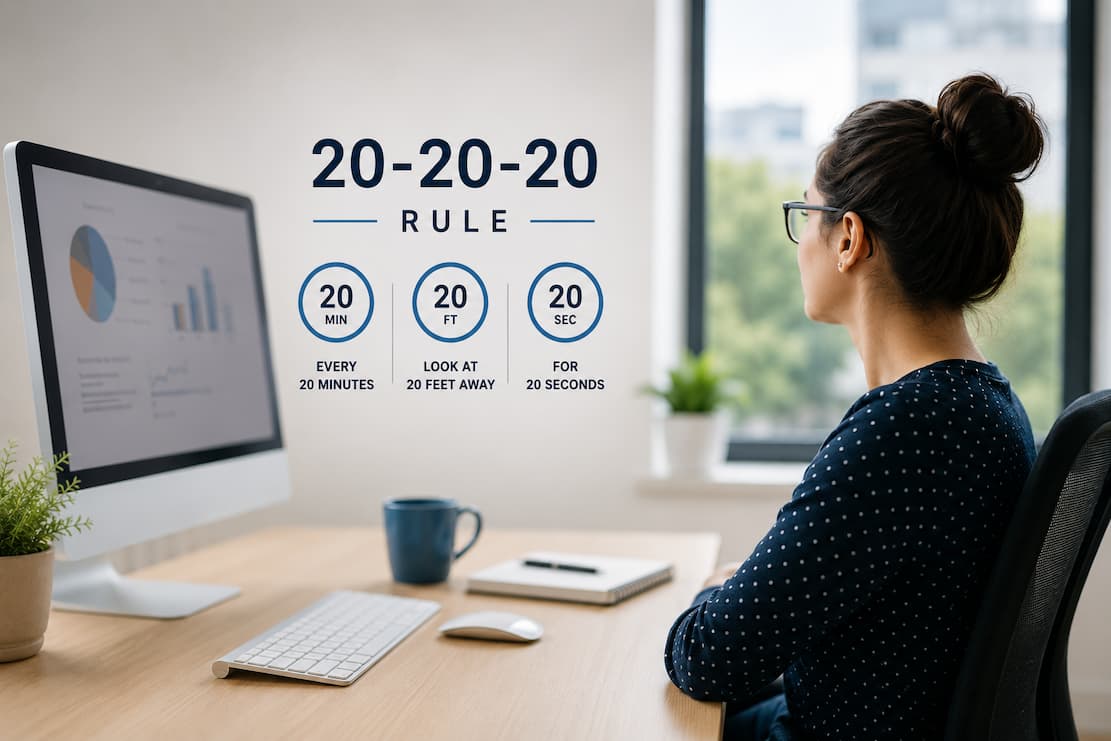
The 20-20-20 rule is not a new fitness trend or a complicated software setting. It is a basic habit: every 20 minutes, look at something 20 feet away for 20 seconds. That is it. No apps required. No special equipment. Just a brief shift in focus that gives your eye muscles a chance to reset. In 2026, as remote work and hybrid schedules have become permanent fixtures rather than temporary adjustments, this small practice has become more relevant than ever.
What Actually Happens to Your Eyes During a Workday
When you focus on a screen, your eyes are in a constant state of tension. The ciliary muscles inside each eye contract to keep nearby text sharp. Over time, these muscles fatigue just like any other muscle in your body. The result is digital eye strain, also known as computer vision syndrome. Symptoms include dry eyes, headaches, blurred vision, neck pain, and difficulty concentrating. A 2023 report from the American Optometric Association found that nearly 58 percent of adults who use screens for more than four hours daily experience at least three of these symptoms regularly.
The problem worsens because most people blink less when looking at screens. Normally, humans blink about 15 to 20 times per minute. During screen use, that rate drops to 5 to 7 times per minute. Fewer blinks mean less moisture across the eye surface, which leads to dryness, irritation, and that gritty feeling you notice after a long video call.
Where the 20-20-20 Rule Comes From
Dr. Jeffrey Anshel, an optometrist in California, developed the 20-20-20 rule in the early 2000s as a practical response to the rise of desktop computing. He wanted a memory-friendly guideline that patients could actually follow without timers, apps, or complex instructions. The simplicity is intentional. Twenty minutes is short enough to prevent significant muscle fatigue. Twenty feet is far enough to relax the focusing system. The ciliary muscles can release tension in just twenty seconds.
The rule has since been endorsed by the American Academy of Ophthalmology, the Vision Council, and occupational health organizations worldwide. It is not a cure for underlying vision problems, but it is a proven method for reducing the daily wear and tear that screens inflict on healthy eyes.
Why 2026 Makes This Habit Non-Negotiable
Work patterns have shifted permanently. The average screen worker now spends 6.8 hours daily in front of a monitor, according to 2025 data from Statista. That is up from 5.2 hours in 2019. Remote workers often lack ergonomic setups. Kitchen tables, couches, and coffee shops have replaced proper desks and adjustable chairs. Eye strain complaints to human resources departments rose 34 percent between 2022 and 2024, based on a survey of 400 companies conducted by the International Facility Management Association.
Additionally, the content we consume has changed. Video calls, scrolling feeds, and rapid task-switching demand more visual attention than reading a static document. Your eyes are constantly refocusing, tracking movement, and adjusting to changing light levels. The 20-20-20 rule was designed for use with static monitors. In 2026, it is even more necessary because the visual demands are higher.
How to Actually Follow the Rule Without Losing Focus
The biggest objection people raise is practical. How do you manage to pause every 20 minutes without interrupting your workflow? The answer is simpler than most expect. You do not need a loud alarm or a distracting app. A few quiet strategies work better.
First, align the rule with natural breaks. After every email you send, every document you close, or every task you complete, look up and find a distant object. A tree outside, a building across the street, or even a wall clock across the room qualifies. The distance matters more than the object itself. If you work in a small space, looking out a window is ideal. In the absence of a window, direct your attention to the farthest corner of the room.
Second, use the Pomodoro technique as a framework. Work in 25-minute blocks, then take a five-minute break. During those five minutes, look at something distant. This combines productivity timing with eye care without adding extra steps to your day.
Third, position your monitor correctly. The top of your screen should be at or slightly below eye level, about 20 to 24 inches from your face. This reduces the angle your eyes must maintain and naturally encourages more frequent glances away from the screen.
What the Science Says in 2026
Recent research continues to validate the 20-20-20 rule. A 2024 study published in the Journal of Occupational Health examined 300 office workers over six months. The group that practiced the 20-20-20 rule reported a 41 percent reduction in eye strain symptoms compared to a control group. A separate 2025 study from the University of Melbourne tracked blink rates and found that participants who took regular distance breaks blinked 28 percent more often, which directly correlated with lower reports of dryness and irritation.
There is also emerging evidence that the rule helps with mental fatigue. When your eyes relax, your brain follows. The constant near-focus of screen work creates a low-level stress response. Brief distance viewing activates the parasympathetic nervous system, which lowers heart rate and reduces cortisol levels. In other words, the 20-20-20 rule is not just for eye care. It is a micro-recovery technique for your entire nervous system.
Common Mistakes People Make
Despite its simplicity, many people implement the rule incorrectly. The most common error is looking at a phone during the break. A phone screen is held 12 to 16 inches from your face, which does not relax the ciliary muscles at all. You are essentially switching from one near-focus task to another. The second mistake is looking at something 20 feet away but only for five seconds. The muscles need the full 20 seconds to release tension. The third mistake is ignoring the rule entirely during video calls. Back-to-back meetings create the worst conditions for eye strain because you are both viewing a screen and maintaining intense focus on faces and expressions.
Pairing the Rule With Other Habits
The 20-20-20 rule works best as part of a broader approach. Consider these complementary habits that take minimal effort but multiply the benefits.
Adjust your screen brightness to match your surroundings. A screen that is significantly brighter or darker than the room forces your eyes to constantly adapt. Most operating systems now include automatic brightness adjustment, but manual tweaking is often more accurate. Reduce blue light exposure in the evening. While the link between blue light and permanent eye damage remains debated, studies consistently show that blue light suppresses melatonin production, which affects sleep quality. Use night mode settings or software like f.lux after sunset.
Stay hydrated. Dry eyes are often a symptom of general dehydration. If you drink coffee throughout the day without water, your eyes suffer along with the rest of your body. Keep a bottle at your desk and finish it before lunch. Finally, get an annual eye exam. Prescription changes, even small ones, increase the effort your eyes expend to focus. An updated prescription can reduce strain more than any habit adjustment.
When to See a Professional
The 20-20-20 rule addresses normal screen fatigue. It does not fix underlying conditions. If you experience persistent double vision, severe headaches, light sensitivity, or vision changes that do not improve with breaks, schedule an appointment with an optometrist. These symptoms can indicate astigmatism, presbyopia, or other issues that require correction. Early intervention prevents long-term damage and often reveals that a simple prescription update solves the problem entirely.
Real-World Impact on Productivity
Companies that have promoted the 20-20-20 rule internally report measurable results. A 2025 case study from a financial services firm in London tracked 120 employees for three months. After implementing the rule through calendar reminders and brief training sessions, the company saw a 19 percent decrease in reported eye strain and a 12 percent increase in self-reported focus during afternoon hours. The program cost nothing except the time to explain it. The return came from fewer sick days and from higher sustained attention.
Individual workers report similar effects. Freelancers and remote employees who adopt the rule often notice that their afternoon slump arrives later or disappears entirely. The reason is straightforward. Eye strain is an energy drain. When your eyes are comfortable, your brain has more resources available for actual work.
Building the Habit for Long-Term Health
The challenge with any preventive habit is consistency. The 20-20-20 rule fails when people try it for two days, forget on the third, and abandon it by the fourth. The solution is to anchor it to existing routines. Every time you save a file, look away. Every time you finish a call, stand up and find a distant focal point. Every time you reach for your coffee, glance out the window. These anchors make the rule automatic rather than effortful.
After two weeks of consistent practice, most people no longer need reminders. The relief becomes its own motivation. Your eyes feel better, your headaches diminish, and your work quality improves. The habit becomes self-sustaining because the benefits are immediate and tangible.
Final Thoughts
In 2026, screen work is not going away. It is expanding. The tools we use, the hours we log, and the intensity of our visual focus are all increasing. The 20-20-20 rule remains one of the few defenses that requires no money, no technology, and no significant time investment. It is a small pause with a large return. For screen workers who want to protect their vision, maintain their focus, and avoid the chronic fatigue that defines modern work life, this simple habit is not optional. It is essential.
Related Articles
Explore more insights on digital wellness and screen habits:
Sources and References
- American Optometric Association. (2023). Computer Vision Syndrome and Digital Eye Strain Report. Retrieved from aoa.org
- Anshel, J. (2007). Visual Ergonomics in the Workplace. Taylor & Francis.
- Statista. (2025). Average Daily Screen Time of Adults Worldwide. Retrieved from statista.com
- International Facility Management Association. (2024). Workplace Health and Ergonomics Survey 2024.
- Yamamoto, S., et al. (2024). “Effects of the 20-20-20 Rule on Digital Eye Strain in Office Workers.” Journal of Occupational Health, 66(3), 215-223.
- Thompson, R., & Lee, K. (2025). “Blink Rate Variations During Screen Use and Distance Viewing Breaks.” University of Melbourne, School of Optometry.
- Vision Council. (2024). Annual Blue Light and Digital Eye Strain Report. Retrieved from thevisioncouncil.org
- American Academy of Ophthalmology. (2025). Eye Health Tips for Computer Users. Retrieved from aao.org
- Harvard Health Publishing. (2024). “Blue Light Has a Dark Side.” Harvard Medical School. Retrieved from health.harvard.edu
Nathan Hayes is a technology writer at Pimozoogin who covers AI, digital wellness, smart healthcare, and emerging technology trends. He creates simple, informative content that helps readers understand how modern technology is influencing everyday life, productivity, fitness, and connected living.