
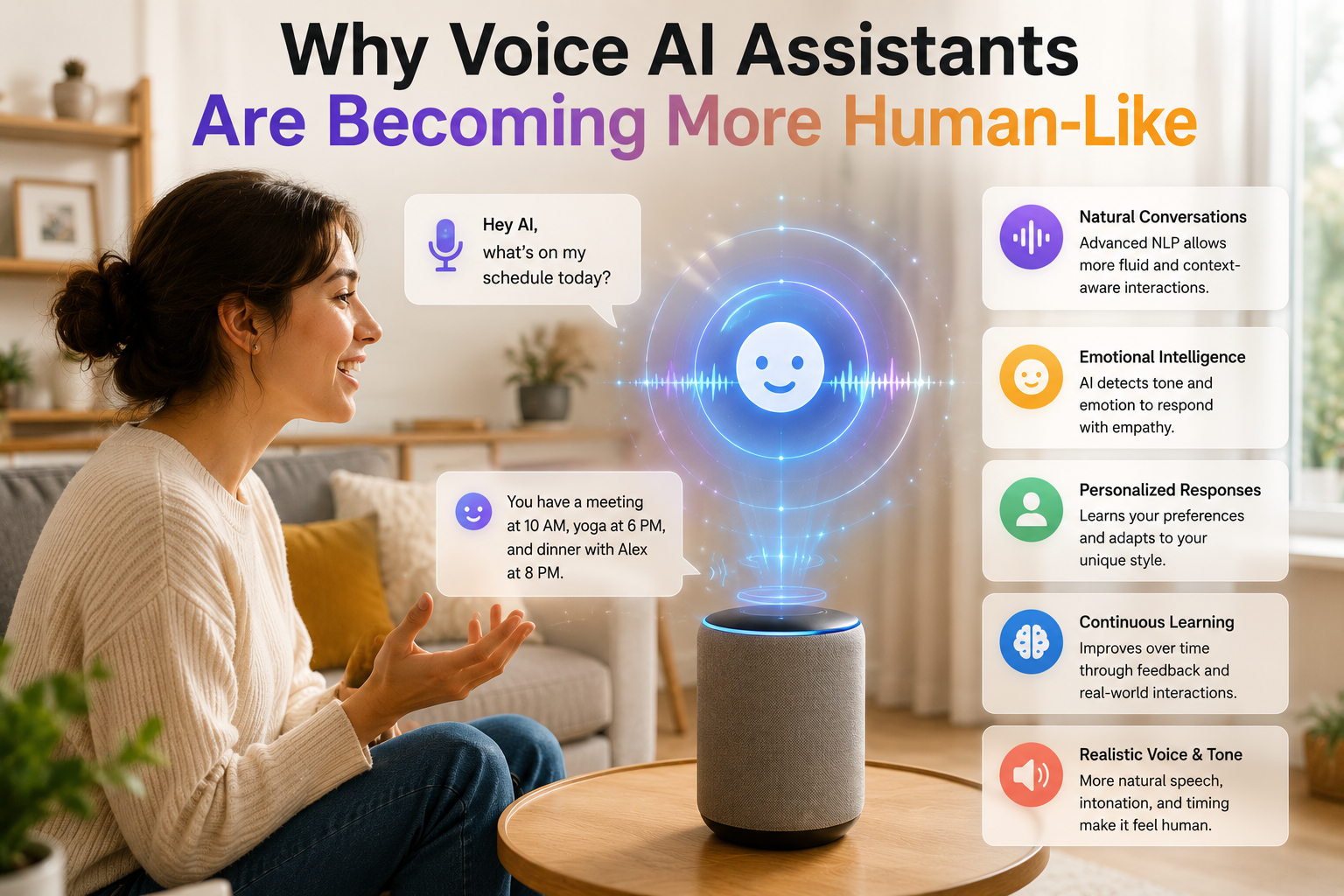
In the past, talking to a machine was like talking to a wall that only repeated sentences. You asked a question, received a mechanical answer, and then realised that you weren’t actually communicating with anyone. But this feeling is changing rapidly. Nowadays, voice-controlled AI assistants are so natural, responsive, and emotionally engaging that users often forget they are talking to an AI.
This change is not just technological. People are learning how to communicate with machines, and robots are learning how to respond in familiar, warm, and unexpected ways. If you have used Siri, Google Assistant, Alexa, or other new voice-controlled AI, you have probably already noticed the difference. Conversations flow more smoothly, responses are more context-aware, and assistants sometimes even anticipate your needs before you say anything. What is driving this change? Why are voice-controlled AI assistants becoming increasingly human? And what impact will these changes have on our lives?
The Shift from Commands to Conversations
Initially, voice technology was used to execute strict commands. The requirements for the voice were very specific, almost as if you were programming a machine. If you said something wrong, the assistant often didn’t understand it. The process is mechanical and cumbersome, especially when communicating with a human who can deduce incomplete sentences from context.
Now, that is completely unique. Voice-controlled AI assistants can recognise natural language. Even if you pause or change your sentence, the technology can follow your speech. One of the reasons why AI feels more human is that it has shifted from command-based comprehension to conversation-based comprehension. Many people no longer say “Set your alarm for 6 o’clock in the morning,” but rather “Can you wake me up around 6 o’clock tomorrow?” The assistant understands the intent, not the words. This subtle difference provides users the feeling that they are talking to a helpful person, rather than programming a machine. Better language models and training in human conversation reinforce this further. The goal is now fluent, natural, human-like interaction, not accuracy.
How Natural Language Processing Changed Everything
Natural language processing gives voice assistants human-like responsiveness. It helps robots understand the meaning, tone, and context of speech. Previous systems only looked at keywords. For example, you said “weather in Karachi”, and the system would search for “weather” and “Karachi” separately and link the results. However, modern systems interpret your request for precise information about a specific location as a complete intention.
Everything is more human here. Meaning is how people think, not terms. Conversations with friends don’t need to have complicated structures; you just need to express your thoughts. Now, voice-controlled AI assistants handle this natural, fluid communication. It is even more interesting to see how these systems learn. Due to increased interaction, humans can better recognise accents, dialects, and speaking styles. Thanks to its versatility, current voice-controlled AI is more natural and less mechanical than it was a few years ago.
The Role of Machine Learning in Human-like Behavior
Natural language processing (NLP) is responsible for interpreting text, while machine learning continuously improves speech AI over time. The system learns from every interaction and constantly optimises its responses. Imagine asking your voice assistant for traffic information every day before work. Over time, it learns your daily habits. It can automatically provide traffic information or advise you to leave earlier during rush hour. This is no coincidence but pattern recognition formed by machine learning.
This human-like feeling stems from familiarity. AI adapts to your behaviour, just like a colleague. It does not “understand” you but reproduces understanding through data patterns. This simulates human nature. A system that can remember your preferences, respond faster to your frequently asked questions, or adjust its tone to the context feels more like an assistant than a tool.
Why Voice Tone and Speech Synthesis are so Important
It is clear that speech AI assistants sound better. Early versions were flat, mechanical, and easily recognisable. Nowadays, smoother, more expressive, and more natural voices are commonplace. This improvement is due to advanced speech synthesis technology. Modern systems can dynamically synthesise speech, including subtle pauses, pitch variations, and emotional intonation, rather than simply stitching together pre-recorded, mechanical fragments.
Think of the difference between reading a script and speaking naturally. In real life, we communicate very differently. We emphasise certain words, pause when we are thinking, and change our tone when we are emotional. Speech AI gradually mimics these characteristics. When you ask for instructions, an assistant can speak calmly. Newer systems can even adjust their tone based on your urgent request. This seemingly small change can significantly improve the experience of natural interaction. Voice has a profound influence on human perception. Even with the same content, a more natural voice sounds more credible and pleasant.
Context Awareness Makes Conversations More Realistic
Context awareness is a major advancement in speech AI. In the past, every question corresponded to an independent interaction. Now, assistants can remember previous conversations and respond to them. For example, if you ask: “What is the capital of France?” followed by “How far is it from here?”, the assistant knows that “it” refers to Paris. Maintaining contextual information makes conversations more natural and fluid. Human communication relies heavily on context.
Repeated explanations rarely occur. Instead, we use pronouns, assumptions, and references. Voice-controlled AI assistants follow this example. This improvement enables longer conversations. You can clarify requests, ask more questions, or change the subject without having to restart the conversation. This alone transforms the user experience from mechanical to conversation-orientated.
New Frontier: Emotional Intelligence
Early voice-controlled AI has demonstrated remarkable emotional intelligence. Although machines cannot feel emotions, they are becoming increasingly better at recognising emotional signals in human speech. Some advanced systems can adjust their responses based on whether you sound anxious, tired, or excited. Tone recognition can prompt the system to provide softer, shorter answers or offer supportive advice.
But such technology cannot replace empathy. The ultimate goal is to make interactions easier. When technology can answer questions thoughtfully, users feel less frustrated and more understood. Imagine seeking help in a difficult situation and receiving a calm, concise answer instead of a rushed explanation or technical instructions. Emotional connection significantly improves the user experience. As this technology continues to develop, AI assistants with emotion recognition could potentially become a distinguishing feature and come across as truly human.
Everyday Life is Gradually Adapting to Voice-controlled AI
Voice-controlled AI is quietly integrating into our daily lives, a transformation that is becoming increasingly fascinating. Not everyone realises how often they use voice assistants. People check the weather while cooking, set reminders while driving, and operate smart devices at work. Voice-controlled AI has become a silent companion in many households. It can turn on lights, play music, read messages aloud, and answer various questions without the need for a screen or typing. This hands-free convenience makes interaction more natural and seamlessly integrated into daily life.
Over time, these assistants are no longer machines, but rather a part of nature. This psychological shift is crucial. The more natural the relationship, the easier the technological communication. It is comparable to how we no longer view typing as ‘technology.’ This phenomenon is due to normalization. Voice-controlled AI follows this trend and is becoming even more natural.
The Future of Humanoid Voice-Controlled AI Assistants
Future voice-controlled AI assistants may become even more deeply integrated into daily life. Systems could emerge that can understand deeper emotional meanings, hold longer and more meaningful conversations, and adapt their personality traits to the user’s preferences. Users can choose voice assistants with formal, friendly, humorous, or professional characteristics, depending on their needs. This personalisation will result in a richer interactive experience.
Moreover, the importance of privacy and ethical design will become increasingly significant. As assistants become more human, users will expect transparency regarding data usage and decision-making processes. However, the direction of development remains clear. Voice AI will ensure that interacting with technology feels like interacting with a helpful, real assistant—faster and easier.
Conclusion
Thanks to advances in language comprehension, machine learning, speech synthesis, and context-aware technologies, voice AI assistants are becoming increasingly human. These innovations are transforming simple devices into natural conversational partners.
What were once rigid commands have now become everyday conversations. The gap between these systems and humans is rapidly narrowing. With further technological advancements, speech AI could become one of our most natural ways of digital interaction.
FAQs
1. Why do voice-controlled AI assistants sound more natural now?
Modern speech AI adds intonation, pauses, and emotional nuances to speech, making it sound more natural.
2. Can voice-controlled AI assistants understand emotions?
They cannot experience emotions, but they can recognise vocal cues and adjust their responses to the user’s tone or emotion.
3. Why are modern speech assistants more intelligent?
Thanks to natural language processing and machine learning technologies, they can better understand the context, intent, and content of a conversation.
4. Can speech assistants remember the content of a conversation?
Some systems can remember the context of a conversation in the short term, making subsequent questions easier.
5. Will speech AI replace human interaction?
Speech AI is a tool for human interaction, not a replacement. Although it is useful, it cannot fully replicate the depth of human interaction or emotion.

Nathan Hayes is a technology writer at Pimozoogin who covers AI, digital wellness, smart healthcare, and emerging technology trends. He creates simple, informative content that helps readers understand how modern technology is influencing everyday life, productivity, fitness, and connected living.