
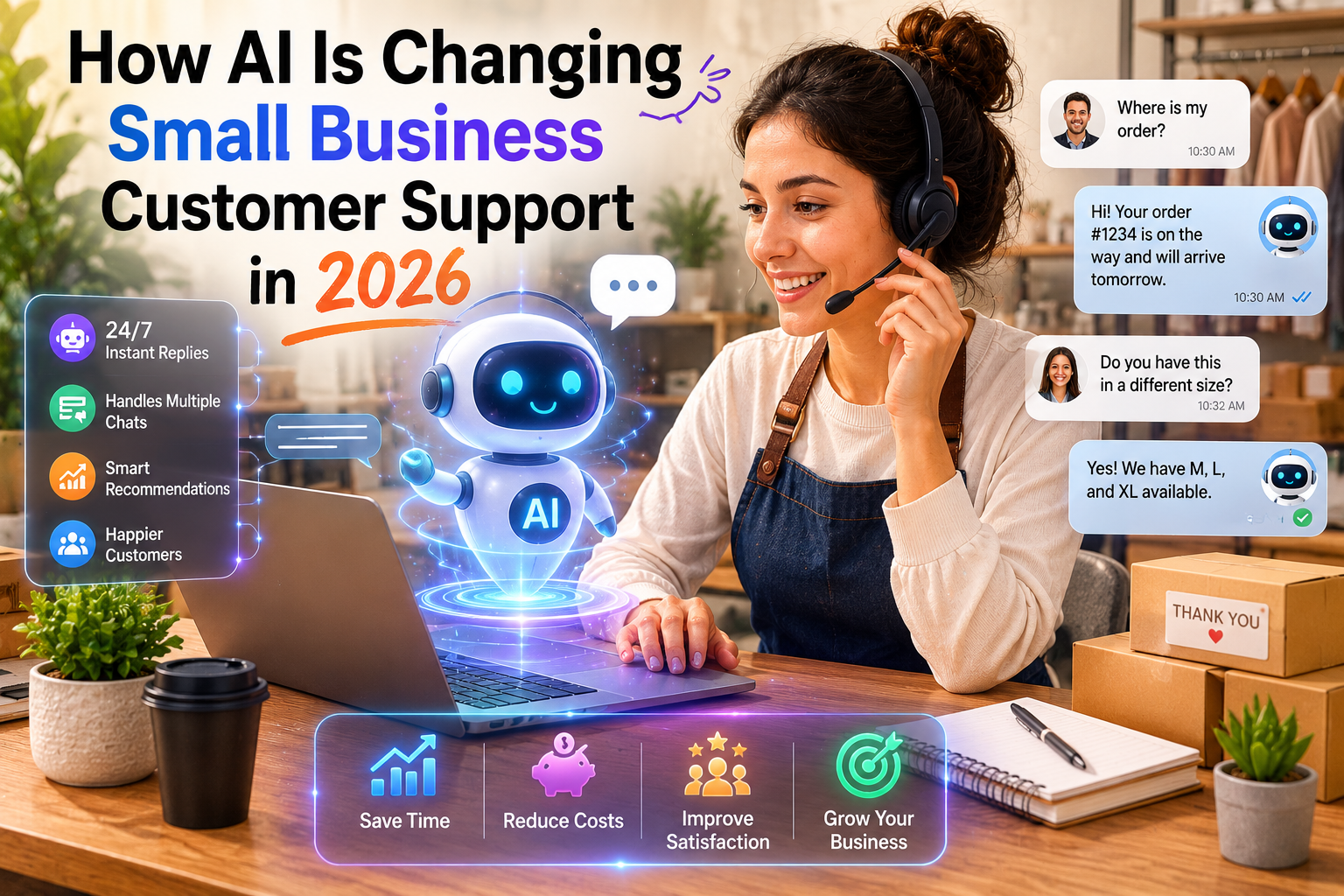
Customer service will undergo a revolutionary transformation in 2026, particularly for small businesses that want to remain competitive in a rapidly evolving digital world. Artificial intelligence (AI) plays a crucial role in this shift, bringing convenient, practical, and everyday changes to customer service for small businesses. In the past, customers sometimes had to wait hours or even days for an email response or stood in long queues. Today, customer service is faster, more efficient, and available 24/7. Intelligent solutions help small businesses answer customer enquiries, guide customers, and resolve common issues without human intervention. This development not only takes technology to a higher level but also improves communication and customer relationships. This transformation is particularly important for small businesses, which typically have limited staff. AI can answer repetitive questions, allowing employees to focus on more important customer interactions. The result is that customer service is now faster, more consistent, and more efficient than ever before.
Faster Daily Response Times for Customer Service
The response time for customers is one of the biggest benefits of AI. In the past, employee absence often delayed even simple questions such as opening hours or order status. AI systems can now respond immediately, thereby adjusting customer expectations. Artificial intelligence (AI) helps small businesses respond quickly and clearly to customer enquiries. It understands common questions and provides prompt answers. Customers feel heard and respected, even outside of office hours. Small businesses benefit enormously from no longer having to rush to respond to every message. AI handles daily conversations, while humans intervene when necessary. This balance reduces the workload for the team and ensures better support. Because the answers are natural and fluid, customers often do not realise they are speaking with an automated system. The speed advantage of AI will significantly improve customer service for small businesses by 2026.
24/7 Service for Small Businesses
AI enables small businesses to provide 24/7 customer service without a large team. Previously, small businesses only offered support during office hours, which led to lost or delayed information. AI solutions enable customers to get help anytime, anywhere, even on holidays. This continuous service is more convenient and reliable for users who need information quickly. AI can answer product questions in the middle of the night without having to wait until the next day. AI, once the domain of large corporations, is now benefiting small businesses as well. It creates equal opportunities, allowing small brands to compete. Moreover, AI increases customer trust because help is always available. Thanks to this continuous support, artificial intelligence (AI) will radically change customer service for small businesses by 2026.
Using AI for Personalized Customer Experiences
Today, customer service encompasses more than just answering questions; it also involves identifying individual customer needs. Small businesses can easily deploy AI to personalise their services by analysing customer behaviour, preferences, and past interactions. This means that responses will be more personal. If a returning customer seeks help, AI can recognise their past activities and offer recommended solutions. Although the technology itself is human and thoughtful, it makes the customer experience even more human and attentive. Small businesses can benefit from building closer relationships with customers without needing a large customer service team. AI helps companies approach customers in a more personal way, rather than with generic answers. This contributes to higher customer satisfaction and retention. Personalised service reduces customer frustration because customers do not have to keep asking the same questions. The entire process runs more smoothly and seamlessly. The ability of AI to personalise experiences is one of the key reasons why it will transform customer service and user interactions for small businesses by 2026.
Reducing the Workload of Teams in Small Businesses
Small business owners must strike a balance between staffing levels and the ever-increasing demand from customers. Artificial intelligence (AI) solves this problem by automating time-consuming tasks. Customers often ask simple questions, such as updates on shipments, refund procedures, and product details. AI can answer these questions without human intervention. The reduced workload allows customer service teams to focus on more complex or sensitive situations that require human intervention. As a result, employee stress decreases and productivity increases. Burnout, caused by manual management tasks that are common in small teams, is also reduced. AI saves companies time and effort by handling routine tasks. This supports, rather than replaces, human support. The combination of automation and human-machine interaction ensures smoother workflows. This balance is one of the reasons why AI will transform and make customer service for small businesses more comfortable by 2026.
Improving Communication Between Businesses and Customers
Good customer service requires clear communication, and AI can improve this. Slow, vague, or inconsistent responses lead to many misunderstandings. Structured and easy-to-understand AI responses alleviate these problems. It simplifies information, allowing customers to immediately understand what they need to do. Small businesses benefit from this consistency, as it ensures clear communication with all customers. AI technology helps manage large volumes of chats, reducing delays and missing information. Interactions become more organised and reliable. Even if the entire solution takes some time, customers benefit from quick responses. AI streamlines communication processes. By making communication predictable and useful, it builds trust between businesses and customers. Thanks to greater clarity and consistency, AI will also transform customer service for small businesses by 2026.
AI Makes Multilingual Support Easy
In today’s global economy, many small businesses serve customers in multiple languages. AI can quickly translate and respond in various languages, making multilingual support much easier. This removes a fundamental barrier to communication between businesses and customers. In the past, small businesses often missed opportunities or became frustrated because they did not understand information. Now, AI can translate messages and respond in the customer’s language. This makes a broader audience feel welcome. It also enables companies to expand their operations without multilingual staff. When customers can communicate in their language, their satisfaction and trust increase. Companies can continue to provide high-quality support services in different regions. In 2026, with the explosive growth of online commerce, this skill will become even more important. Artificial intelligence (AI) will streamline multilingual communication for small business customer service and enable global interaction.
Deeper Insight into Customer Needs
In addition to answering customer questions, AI can help companies understand their customers better. AI can identify popular products, customer challenges, and concerns by analysing conversations and patterns. Small businesses will benefit enormously from this information, as it helps them choose the right services. Companies can utilise real customer interactions to determine customer needs. If many buyers ask the same questions, it may be necessary to clarify the website or product descriptions. These insights help companies improve customer service and the customer experience. AI reveals how customer needs change over time by identifying trends. It helps small businesses adapt and respond. Automated data collection helps companies make human-centred decisions. By better understanding customers, companies can improve their interactions and services. By 2026, AI will also transform the way small businesses provide customer service through analytics.
Challenges and Responsible Use of AI in Support Systems
Artificial intelligence (AI) offers countless benefits, but small businesses must overcome the challenges it presents. Maintaining a human connection with customers is crucial. Although AI can answer many questions, some people still prefer interacting with real people. Companies must strifindalance between automation and human service. Ensuring the accuracy and usability of AI responses is another major challenge. Monitoring is essential, as systems can misinterpret customer needs or provide inappropriate answers. Small businesses must process customer data securely and correctly. Customer service is based on trust, and that trust must be maintained. Regular training and updates of AI systems can improve performance and resolve issues. System design must also allow for an easyeffortlesstch from AI to human customer service when necessary. Companies can better utilise AI by taking these aspects into account. This balanced approach ensures that AI will have a positive and sustainable impact on small business customer service by 2026.
The Future of AI in Small Business Customer Service
AI will play a larger role in customer service, particularly for small businesses. Advanced systems are becoming increasingly natural in conversations and are recognising customer needs increasingly better. This means that customer service will become better and easier. Small businesses can deploy AI to guide customers in identifying problems, solving them, and answering their questions. Human interaction remains crucial, especially in complex or sensitive situations. In the future, the we will likely combine the efficiency of artificial intelligence (AI)h human empathy to provide optimal support. As technology continues to evolve, small businesses will gain more opportunities to improve communication and customer interaction. AI is a transformative force in the long term in the business world, and its continued development proves thisits worth 2026, AI will make customer service for small businesses faster, smarter, and better connected.
FAQs
1. How will AI impact customer service for small businesses in 2026?
Small businesses use AI to answer customer enquiries, manage tasks, and communicate better. This allows companies to provide faster and more consistent service without needing a large team.
2. Can AI completely replace customer service staff?
AI cannot completely replace humans. It can perform simple, repetitive tasks, but complex, emotional, or sensitive customer situations still require human intervention.
3. How can AI improve customer service for small businesses?
AI improves the customer experience through direct, personalised, and 24/7 responses. It can also reduce waiting times and improve communication.
4. Is AI customer service suitable for all small businesses?
AI support can help most small businesses, especially those that regularly receive customer enquiries. The specific use depends on the type of business and the customer’s needs.
5. What is the biggest advantage of artificial intelligence in customer service?
The main advantage is efficiency. Artificial intelligence can help companies respond to customer needs faster, reduce the burden on customers, and communicate consistently, thereby improving customer satisfaction.

Nathan Hayes is a technology writer at Pimozoogin who covers AI, digital wellness, smart healthcare, and emerging technology trends. He creates simple, informative content that helps readers understand how modern technology is influencing everyday life, productivity, fitness, and connected living.