
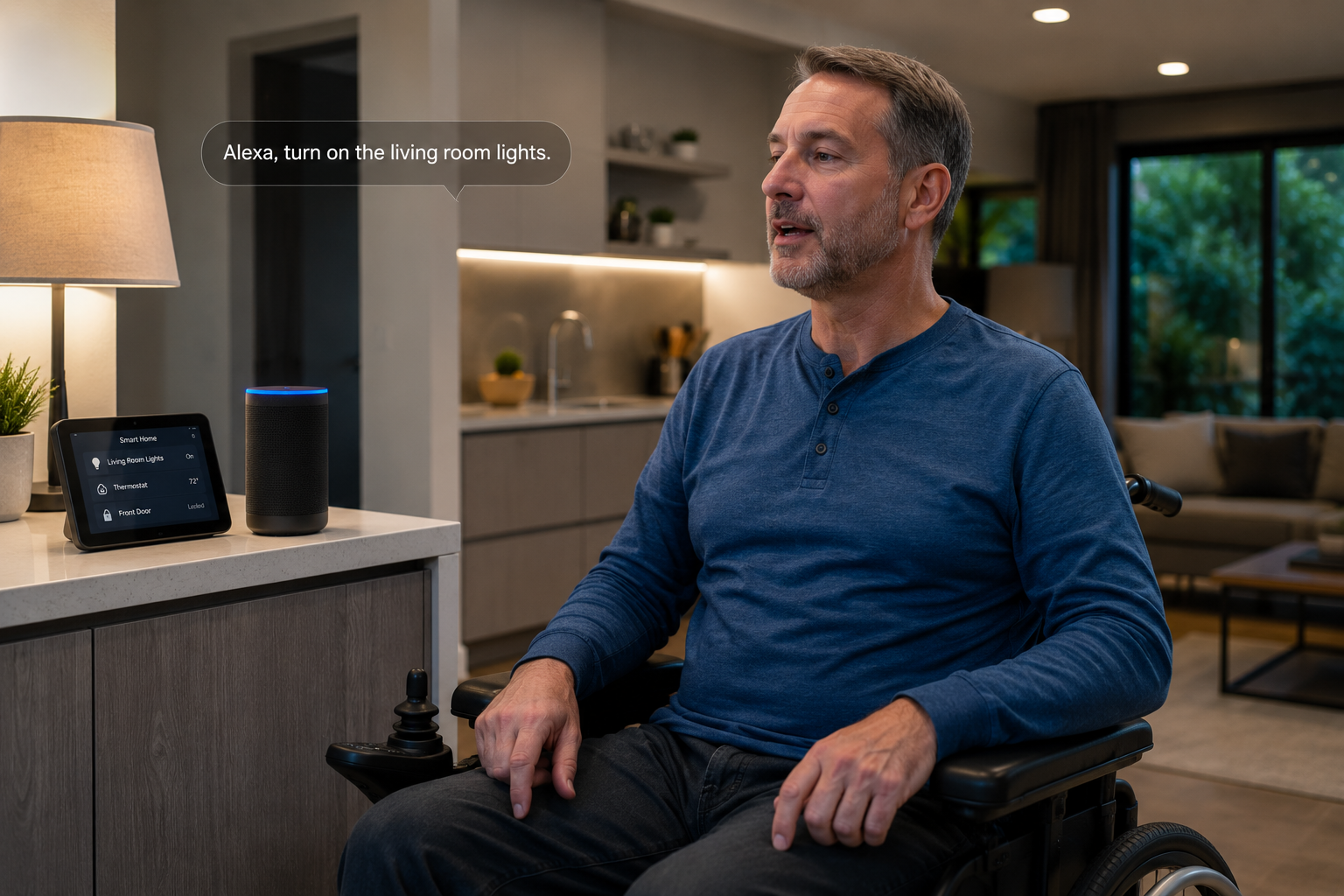
For people with limited mobility, everyday routines often require more physical effort than most others realise. Something as simple as turning off a light, adjusting a thermostat, answering a phone call, or changing television channels may require assistance, extra movement, or adaptive equipment.
This is one reason voice-controlled technology has become increasingly valuable in accessibility-focused environments.
Voice assistants, smart speakers, and connected home devices allow users to control certain parts of their surroundings through spoken commands rather than physical interaction. While the technology may seem convenient for the average household, for many people with mobility limitations, it can provide meaningful improvements in independence and comfort.
The impact is often less about advanced technology and more about reducing small daily obstacles that gradually add stress and fatigue over time.
What Voice-Controlled Devices Actually Do
Voice-controlled systems use microphones, speech recognition software, and connected devices to respond to spoken instructions.
Some systems work through smart speakers placed around the home, while others operate through phones, tablets, televisions, or smart home hubs.
Common voice-controlled functions include:
- Turning lights on and off
- Adjusting room temperature
- Playing music or television
- Making phone calls
- Sending messages
- Setting reminders
- Locking doors
- Managing smart appliances
- Operating adjustable beds or chairs
Many people already use these features casually. For individuals with limited mobility, however, the same tools may significantly reduce the need for repeated physical movement throughout the day.
Accessibility Is Often About Energy Conservation
One important detail is frequently overlooked in conversations about mobility limitations: physical movement itself can become exhausting.
For some individuals, reaching for switches, standing repeatedly, or moving across a room several times a day may require substantial effort.
Voice-controlled devices help conserve energy by reducing unnecessary physical tasks.
For example, someone with chronic pain or muscle weakness may use voice commands to control lighting, adjust curtains, or answer calls without needing to reposition themselves repeatedly.
Over time, those small conveniences can make home environments feel less physically demanding and more manageable.
Smart Homes Are Becoming More Accessible
Voice technology is increasingly connected to broader smart home systems.
Instead of controlling only one device at a time, users can manage multiple connected systems through a single voice assistant.
A person may say a simple phrase that
- Turns off lights
- Locks doors
- Adjusts room temperature
- Activates nighttime lighting
- Plays calming audio
- Closes smart blinds
This level of automation can reduce frustration while improving comfort and independence within the home.
Importantly, many modern systems are customisable. People can create routines based on their own mobility needs rather than adapting themselves to fixed technology settings.
Voice Commands Can Reduce Dependence on Physical Interfaces
Touchscreens, remote controls, and small buttons are not always easy to use for individuals with mobility limitations, tremors, arthritis, or reduced hand coordination.
Voice interaction removes some of those barriers.
Instead of navigating complicated menus or physically reaching for devices, users can perform actions through spoken requests that feel more natural and immediate.
For some people, this also reduces the emotional frustration that comes from relying heavily on others for routine household tasks.
The technology may seem simple from the outside, but the practical effect can feel significant in daily life.
Communication Features Are Especially Helpful
Voice-controlled devices are not just for smart homes. They have another important advantage: they help people communicate better.
Many devices enable users to:
Make Hands-Free Calls
People with limited mobility can contact family, carers, or emergency contacts without touching the phone.
Send Voice Messages
Voice commands can be used to send short updates or messages.
Access Emergency Assistance Faster
In emergencies, some systems enable users to quickly call for help when devices are difficult to access.
Users and carers feel safer with these communication aids.
Carers Often Benefit Too:
Voice control technology helps people do more independently, reducing the workload for carers.
For example, someone who can independently operate lighting, entertainment systems, alarms, and telephones may no longer need constant physical assistance during the day.
This does not replace patient care, but it can improve everyone’s daily life.
Family members also appreciate tools that facilitate communication without being too cumbersome, such as shared reminders, medication reminders, or remote device management.
Voice Technology Is Becoming More Natural:
Previous speech systems were often unreliable or frustrating because they struggled to correctly recognise speech patterns or accents.
Modern systems have made significant progress in the field of natural speech recognition technology, but some issues remain.
Many devices now allow users to use conversational commands rather than precise sentences. Users can converse more freely, making conversations feel more natural.
This is a welcome change, as mobile technology works best when it is user-friendly and requires little mental effort.
People are more likely to continue using systems when they can be easily integrated into daily conversations.
Privacy Concerns Still Matter:
Although voice-controlled devices are practical, they also raise some clear privacy concerns.
Many systems continuously listen for active sentences, which worries some users about how they store recordings and data. People considering voice control typically want to know the following:
- Are calls recorded?
- How is voice data stored?
- Who can listen to the recordings?
- How do I turn off the microphone?
- What security settings are available?
For families who value accessibility, trust and openness are just as important as practical usability.
Not Every System Works Equally Well;
Voice-controlled devices can be very convenient, but they are not always the best choice.
Background noise, voice variations, network interference, or microphone placement can affect reliability. Speech recognition can also be ineffective due to the way some people speak.
Another Issue is the Complexity of the Installation.
Systems with too many features can be confusing rather than useful. In most cases, simpler installations work better because they focus on meeting daily needs rather than trying out new technology.
In most cases, the best mobile technologies integrate seamlessly into daily life. Speech technology extends beyond home use.
Nowadays, voice-controlled aids are used in public spaces, hospitals, rehabilitation centres, and communities to help people with mobility impairments live independently.
Care institutions are also increasingly using voice systems to assist patients with operating various functions in a room, without having to repeatedly call staff for minor adjustments.
This development shows that more and more people are realising that mobile technology not only makes life easier but, above all, preserves people’s comfort, dignity, and freedom as much as possible.
Conclusion
voice-controlled devices help people with mobility impairments perform daily tasks more easily and independently.
These systems offer practical support that makes living spaces more comfortable and pleasant. Examples include smart home control, hands-free communication, learning personal habits, and automation functions specifically designed for people with disabilities.
Technology works best when it is simple, reliable, and flexible, thus meeting everyone’s needs. Voice-controlled devices do not replace carers or human assistance; on the contrary, they remove unnecessary obstacles that make daily activities difficult.
As accessibility technology continues to develop, voice communication will likely become an important component in creating supportive and independent living environments.
Frequently Asked Questions
How do voice-controlled devices help people with mobility impairments?
With voice commands, people can operate household appliances and communication devices and perform daily tasks without physical intervention.
Which devices can a voice assistant control?
Many different systems can control lighting, thermostats, TVs, telephones, door locks, smart devices, and other connected devices in the home.
Are voice-controlled devices difficult to install?
Some systems are easy to install, but large smart home systems may require more installation. In general, simpler methods are easier to use in the long run.
Can voice assistants call for help in emergencies?
If set up correctly, some voice control systems can make calls or send text messages to emergency contacts.
Do voice-controlled devices work offline?
Many functions require an internet connection, but depending on the device, some limited local functions can also work without an internet connection.

Nathan Hayes is a technology writer at Pimozoogin who covers AI, digital wellness, smart healthcare, and emerging technology trends. He creates simple, informative content that helps readers understand how modern technology is influencing everyday life, productivity, fitness, and connected living.