
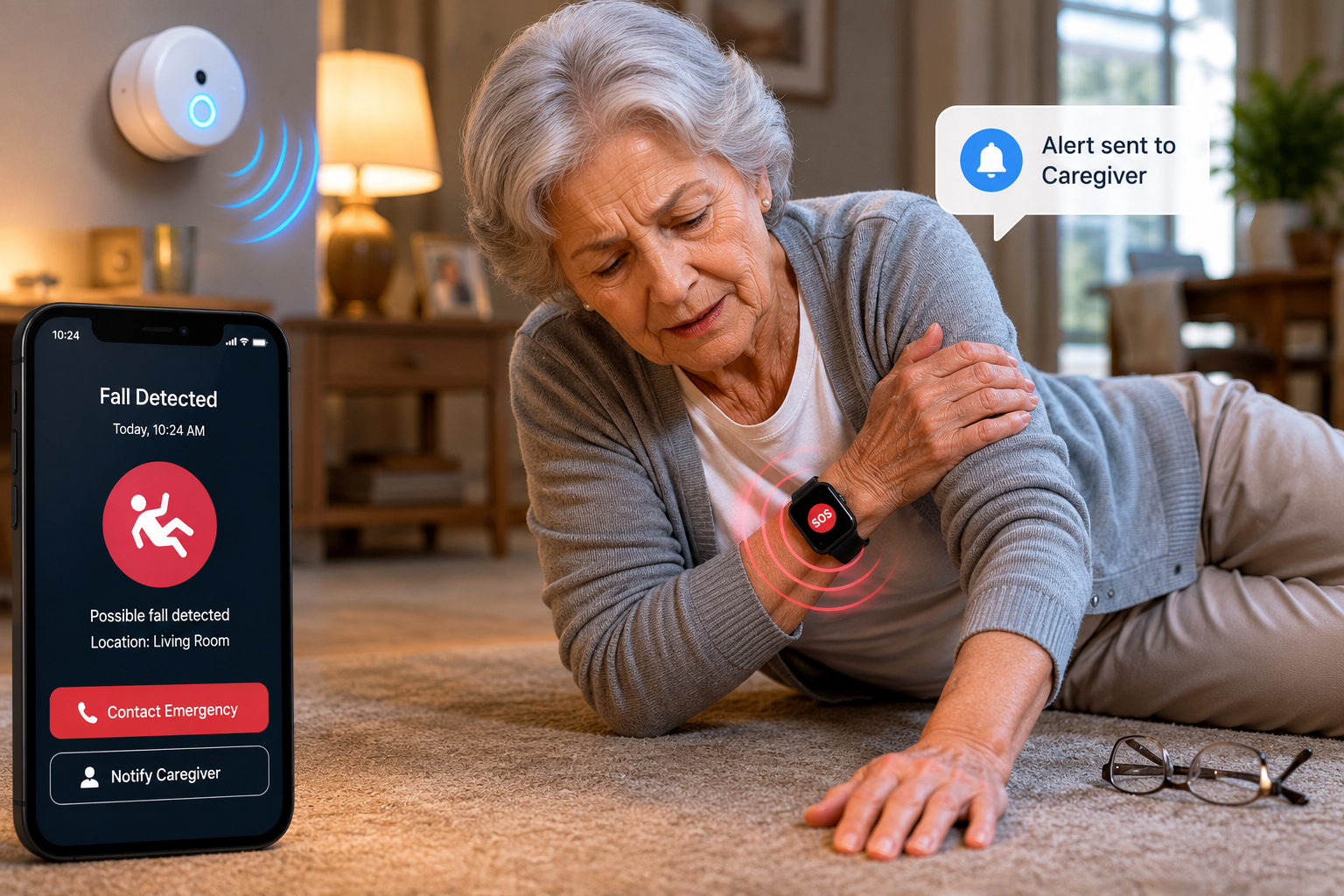
Many seniors strive to continue living independently for as long as possible. Family members often share this wish, but one of the greatest challenges for seniors living alone remains the fear of falling. A simple fall can quickly escalate into a dangerous situation if a senior lives alone, loses their balance, and struggles to reach the phone without immediate action.
Due to this growing concern, more and more nursing homes, residential care centres, and care facilities are installing fall detection systems. These systems are designed to monitor unusual movements and alert carers or emergency contacts when someone is at risk of falling.
The principles may sound complex, but the goal is straightforward to understand. The primary goal of most fall detection systems is to shorten response times, providing an extra layer of safety for seniors who may require emergency assistance.
How Fall Detection Systems Work:
Fall detection systems monitor a person’s movements and search for patterns that may indicate a fall. Various devices are equipped with diverse sensors, but most sensors are designed to detect sudden changes in movement followed by periods of stillness or an unusual body posture.
Many wearable devices are equipped with small motion sensors that record your activity level, direction, and acceleration throughout the day. If there is a rapid descent followed by a severe impact or prolonged stillness, the system may interpret the event as a fall.
Some devices automatically and quickly contact care providers or emergency centres. Other devices ask the user if they need help before triggering an alarm. This extra step helps reduce unnecessary emergency calls resulting from daily activities or accidents.
Wearable Technology Remains the Most Common Choice:
Currently, wearable technology is the most widely used fall detection system for the elderly. These devices usually transform into watches, necklaces, wristbands, or clip-on accessories, offering a comfortable fit and suitability for all-day use.
Portability is one of the reasons why smart technology remains popular. Seniors can use it while moving around the house, visiting family and friends, or going out. Many new devices combine fall detection with other features, such as step counting, emergency contact settings, and reminders to help users remember important things.
The success of wearable technology often depends less on the sophistication of the features and more on the ease of use and comfort of the device. If the technology is easy to integrate into the daily lives of the elderly, they are more likely to continue using it.
The Use of Accelerometers and Motion Sensors:
Accelerometers are important technological components in fall detection. This sensor detects changes in the direction and speed of movement. Smartphones already feature similar technology that allows, for example, users to flip screens or detect body movements.
Fall detection systems use accelerometers to measure the speed and suddenness of body movements. If the software detects a sudden fall or impact, followed by little further movement, it can flag the event as a suspected fall.
Most modern systems do not rely on a single action. Instead, they combine multiple signals to prevent overreactions to normal actions such as quickly sitting down or placing a device on a table.
This multi-layered approach improves reliability, but no single system can eliminate false alarms.
How Gyroscopes Improve Detection Accuracy:
Many advanced fall detectors also contain gyroscopes. While accelerometers measure the speed of an object’s movement, gyroscopes help track the position and rotation of the body.
This is crucial because a person’s posture usually changes visibly during a fall. For example, the system can detect that someone goes from standing to falling in a short period of time.
By combining motion tracking and orientation data, the device can determine more accurately whether someone has fallen. This is especially important in daily life, as people unconsciously bend down, sit down, exercise, and move.
The more information the system has, the better it can distinguish between normal behaviour and potential emergencies.
Smart Home Fall Detection Is Growing Too:
Not all seniors want to wear devices all the time. Some forget to charge their electronic devices, while others find it annoying to wear them constantly.
Therefore, more and more smart home automation systems are integrating fall detection.
These systems do not use wearable devices, but rather devices placed in the room to register activity. Some systems use motion sensors, while others use radar technology, floor sensors, or pressure sensors.
Radar systems are gaining popularity because they can monitor movement patterns without cameras. This makes tracking movements more privacy-sensitive and helps carers see if the person they are caring for is doing what is expected of them or if there is a risk of falling. Many families find camera-less systems more polite and less intrusive than installing full-fledged video surveillance in private spaces.
False Alarms Remain a Challenge:
Finding the right balance between sensitivity and accuracy is one of the most difficult aspects of fall detection technology. Systems that react too quickly may trigger alarms too often, while systems that react too slowly may fail to detect the actual situation in time.
In daily life, many of our movements resemble the rhythm of a fall. Sensors can generate false alarms if you quickly sit down on a couch, fall onto a bed, trip, or accidentally remove the device.
Although software developers are constantly working to improve the reliability of algorithms, false alarms remain an inevitable part of fall detection technology.
Most carers know that these methods are merely supplementary and do not guarantee complete safety. In most cases, their primary value lies in raising awareness and improving communication in potential emergency situations.
Emergency Communication Features Matter Just as Much:
Detecting a fall is only one part of the process. The way communication takes place afterward is equally crucial.
Many new fall detectors have built-in emergency functions that allow users to contact carers, monitoring centres, or other emergency contacts directly. Some systems also enable users to share their GPS location, which is very useful for busy seniors who are often on the go.
Family members are often less interested in technical details and more in the reliability of the alarm and how easily they can respond in an emergency situation.
Simple and user-friendly communication between adults and carers is often the best way to build trust.
More and more people are concerned about their privacy.
Privacy Concerns Are Becoming More Important:
Some people dislike systems that record specific movements or continuously monitor their home. Systems with cameras, especially in private spaces such as bedrooms, are particularly concerning. Therefore, many companies are now focusing on the development of less invasive monitoring systems. These systems use motion detection, radar, or alarms from wearable devices instead of video recordings.
The long-term peace of mind of seniors using these aids depends largely on their trust in the system. With technologies used for the care of the elderly, it is becoming increasingly important to clearly inform users what information is collected and who can access it.
Technology Cannot Currently Replace Human Support:
Despite the growing number of fall detection systems, technology still cannot replace human care and attention.
Although devices can detect emergencies more quickly, they cannot provide psychological support or physical assistance, nor can they help carers make informed decisions. Family members, carers, and healthcare professionals remain the most important factors for the safety and comfort of the elderly.
In general, the best results are achieved by combining practical technology with regular communication, a safe home environment, and attentive care from carers. Fall detection systems are most effective as an additional safety measure, not as the sole solution.
Conclusion:
Fall detection systems are becoming increasingly important in modern elderly care because they increase safety awareness and shorten response times in emergency situations.
These tools utilise smart in-home motion tracking systems, accelerometers, gyroscopes, wearable sensors, and other technologies to help family members and carers better understand the safety needs of the elderly.
Although no single system can completely prevent accidents or guarantee people’s safety, fall detection technology can help and reassure elderly people who wish to continue living independently at home.
As healthcare technology continues to evolve, fall detection systems will likely be used in more homes and care facilities where the elderly reside for extended periods.
Frequently Asked Questions
What does a fall detection system do when it detects a fall?
Most systems use motion sensors and software to detect signals that may indicate a fall, such as speed, rapid changes in body posture, and reduced activity.
Are wearable fall prevention devices reliable?
Many wearable devices perform well for general tracking, but false alarms can still occur if the wearer moves or the device is too sensitive.
Can fall prevention devices automatically call emergency or fire department numbers?
Some systems can directly contact emergency contacts, care providers, or dispatch centres if they detect a potential fall.
Are all fall prevention devices equipped with cameras?
No, many systems do not use cameras. They use motion detectors, wearable sensors, radar tracking, or ground sensors.
Are fall prevention devices only useful for the elderly?
Of course not. Fall prevention techniques can also help people with mobility limitations, balance problems, or certain medical conditions.