
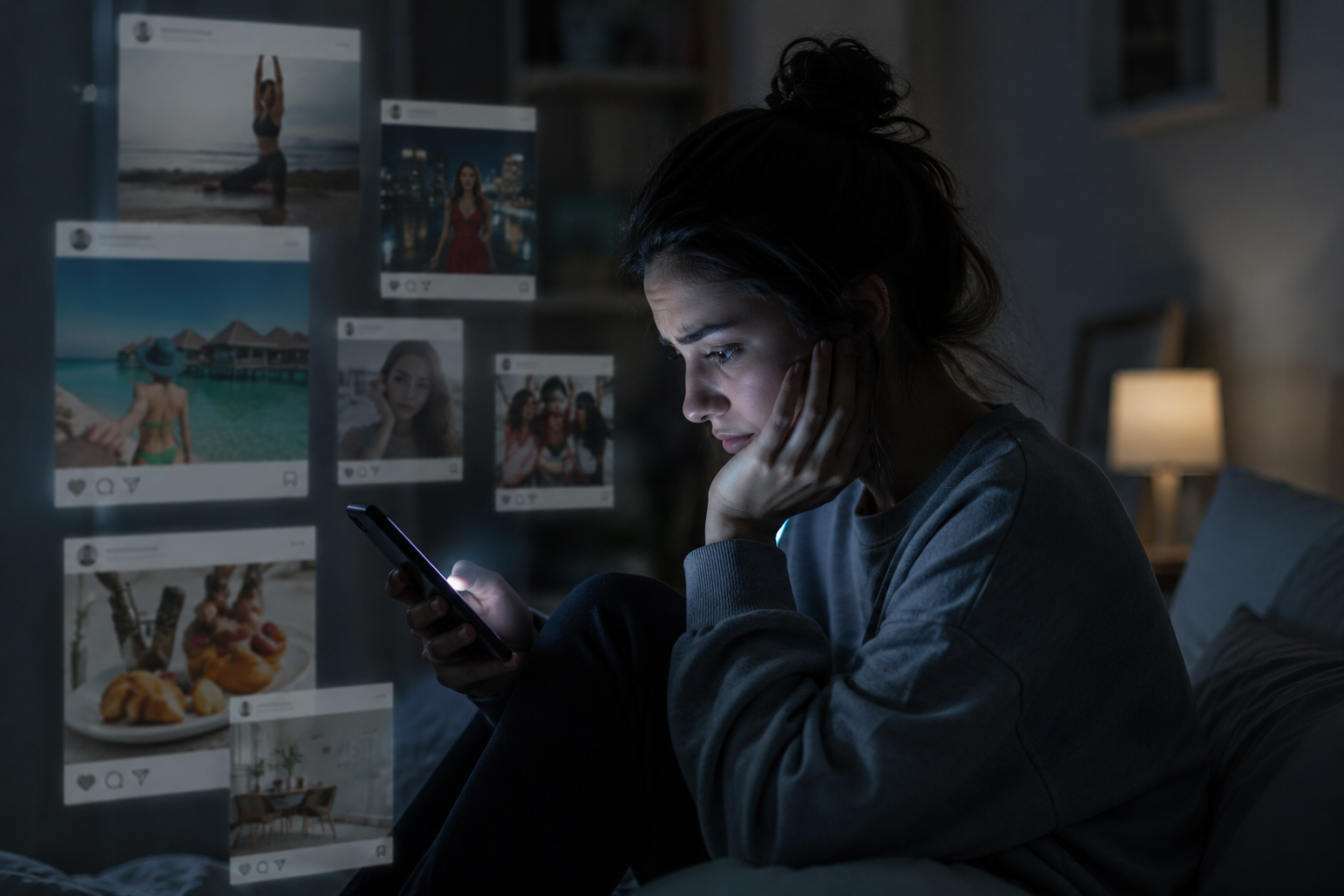
Social media is now a part of our daily lives. Scrolling through feeds is done while eating, sleeping or even taking a short break during the day. At first it seems harmless, as if you were just checking out what other people are doing. Slowly, however, a habit is formed that many people do not even notice: comparison. We compare ourselves, our looks, our achievements and lifestyles to what we see on the internet. This constant exposure to carefully selected moments from others can quietly change how we view ourselves.
Social media often gives an incomplete picture. People share their most beautiful photos, their happiest memories, and the most significant achievements. In the meantime, our lives seem ordinary in comparison. This creates an emotional gap over time between what we experience online and our reality. This emotional gap can affect our confidence without us even realising it. Even when it is not true, the mind begins to think that others are doing better and looking better.
Compare Social Media to other Platforms
Social media comparisons are easy to do, and this is one of the reasons they affect confidence. In the past people used to compare themselves mainly with their friends, coworkers, or neighbours. Comparing people has gone global. We can compare influencers, celebrities and people with entirely different lifestyles in just one swipe. The brain constantly encounters new information, making it difficult to feel satisfied with the journey it has taken.
They are designed to focus attention. Highlight reels are shown instead of the everyday reality. Often, feeds are dominated by bright vacations, flawless outfits, expensive purchases, and perfect body images. The brain begins to normalise such highlights when it sees them repeatedly. Unaware, people start to compare their value with these edited versions. It can lower your confidence, as the online world is often inaccurate.
The Silent Impact of Self-Esteem
Our self-esteem directly shapes how we perceive the world around us. Self-doubt can arise when someone constantly sees content that seems more successful, attractive, or exciting than their life. It does not happen immediately, but over time. Someone may begin to question their appearance, choices, or achievements.
Small thoughts such as “I’m not doing enough” and “My life isn’t interesting enough” can build up over time. Though these thoughts may seem insignificant at first, they can have a negative impact on motivation and emotional wellbeing. This subtle process can be dangerous. Social media is often not associated with a person’s reduced self-confidence because it happens slowly and quietly. They may mistakenly believe it’s a phase or lack motivation when, in fact, the constant comparison is affecting their mindset.
How Curated Content Can Create Unreal Expectations
The nature of the curated content can significantly impact confidence. Social media gives users the opportunity to choose carefully what they wish to share with others. Most posts aren’t random or spontaneous, but rather selected highlights. Filters, editing tools, lighting tricks, and posing all help create a polished image.
It can lead to unrealistic expectations of life when people see this content repeatedly. You may think that everyone is always happy, travelling, successful and confident. This false perception can make people feel as if they’re falling behind when in fact they are progressing at a healthy and normal pace. People share positive moments, but they also leave out important details. Behind every perfect picture, there is a story of struggles, failures, and everyday life. The mind, however, often ignores this fact and only focuses on the visible. This imbalance can affect your confidence and cause you to feel pressured to “keep up.”
Algorithms and the Self-Image
Social media platforms use algorithms to determine what content appears on the user’s news feed. These algorithms are intended to keep users interested for a longer period of time. They often display content that is visually pleasing, emotionally engaging or popular. This increases engagement but also exposes people to unrealistic standards and idealised lifestyles.
This repeated exposure over time can change how people view themselves. Someone who constantly sees fitness influencers or luxury lifestyles may begin to compare their life with these standards. The brain begins comparing personal worth with what it is constantly exposed to, even without any intention. When you are constantly exposed to algorithms, you may find it difficult to avoid comparisons. Even if someone tries to avoid a certain type of content, posts similar to it continue to appear. This leads to a cycle where comparisons dominate scrolling, slowly eroding confidence.
The Emotional Triggers Hidden in Everyday Scrolling
Social media scrolling may seem like a passive pastime, but it can often elicit strong emotional reactions. One post can evoke feelings of admiration or envy, motivation or self-doubt. The emotional reactions are small at first but accumulate over time.
One person’s admiration of someone else’s achievements in the workplace may inspire them, while another might feel like they are behind. Viewing photos of travel can bring happiness to some users, but dissatisfaction to others. It’s all about personal interpretation and the current mindset. Comparing social media to real life can exacerbate feelings of uncertainty in someone who is already experiencing them. Many people don’t notice the emotional impact because it is subtle. Repeated emotional triggers, however, can slowly influence confidence levels. Such behaviour makes a person feel more critical of themselves without realising why.
How Social Media Affects Personal Identity
Confidence and personal identity are closely related. Our identity is how we view ourselves in the world. Social media can blur identity by constantly exposing users to other lifestyles, opinions and appearances. Online users may start to doubt their identity if they spend too much time on the internet.
This comparison can cause internal conflict between what people think they should be and who they actually are. This comparison can cause internal conflict between what they are and what they believe they should be. Such comparisons can lead to a loss of self-confidence over time and pressure on one to alter their values to meet external standards. Comparing makes it harder to be satisfied with your identity. Instead of appreciating one’s own strengths and accomplishments, people focus on perceived weaknesses.
It’s not Easy to be Perfect Online
Social media encourages not only comparison but also performance. Many users are pressured to portray themselves in a particular way. Posting attractive photos, sharing your achievements and maintaining a positive image are all part of the game.
The pressure that you feel can have two effects on your confidence. It can cause anxiety about how others perceive you. It can also make the real world feel less important compared to your online presence. People who focus on appearance instead of experience may begin to measure their value based on comments, likes or followers. It creates a vicious cycle in which confidence is dependent on external validation. Individuals may depend on online feedback instead of feeling confident from within. If that validation is lacking, confidence can quickly drop, even if there has been no change in reality.
Breaking the Cycle of Constant Comparison
Social media comparisons can be detrimental to confidence. However, with awareness and mindful use, it is possible for you to find balance. Understanding that what you see online does not represent the whole picture is the first step. Everyone has their own struggles, insecurities, and everyday challenges that they do not share publicly.
Comparisons lose some of their power when this truth is understood. It is easier to view others as individuals who share certain moments, rather than as standards that must be met. This mental shift helps to reduce emotional stress and encourages confidence growth. A second important change is to be more deliberate with the time you spend on social media. It is easier to feel the effects of certain content when you use social media mindfully rather than automatically. This awareness can be used to choose a healthier digital environment.
Building Confidence In A Digital World
Comparing ourselves to others is not the way to build true confidence. Instead, we need to understand our progress. Social media is rarely an accurate reflection of the pace at which people move through life. When individuals concentrate on their growth, rather than external comparisons, they gain real confidence.
You can slowly rebuild your self-esteem by spending less time comparing your life to online content and more time recognising your personal achievements. Remember that social media only shows a snapshot of a person’s life and not the whole story. Once this perspective is a part of your daily life, you will begin to feel less emotional about comparisons.
Confidence is stronger when it’s based on internal awareness rather than external approval. This internal stability becomes even more crucial in a digital age filled with constant comparison.
Conclusion
Social media comparisons have become a silent force in modern confidence. It may initially seem harmless, but repeated exposure to idealised lifestyles and curated images can gradually change how people view themselves. It can lead to unrealistic expectations, emotional triggers and constant self-evaluation, which can gradually erode self-esteem.
Understanding this impact, however, is the first step towards change. Once people understand how comparisons work, they will be able to distinguish between online and real-life reality. Confidence increases when you shift your focus from others to your own progress and use social media intentionally rather than out of habit. In a world of highlights shared by everyone, the real strength is in appreciating one’s own journey and not comparing it to carefully edited moments from others.
FAQs
1. Why is social media comparison so important?
Social media comparisons can affect confidence because they expose people to highly edited versions of others’ lives. This can make them feel like their life is less successful or interesting.
2. Can reducing social media use improve self-esteem?
Reduced social media usage can improve self-esteem, as it reduces the exposure to constant comparisons and allows for more focus on actual life experiences.
3. Why do people feel worse when they scroll through social media?
Scrolling through social media can make people feel inferior because of idealised lifestyles and images that may cause them to doubt themselves or feel inadequate, even if unintentionally.
4. Is social media always harmful for confidence?
Social media can be harmful, but not always. How you use it will determine whether or not social media is harmful. Positive and mindful use can inspire motivation while excessive comparison can negatively impact confidence.
5. How can someone stop comparing themself online?
To reduce comparison, you should be aware of your emotional reactions as you scroll, limit the amount of time that is wasted, and remember that online content only represents a small portion of reality.