
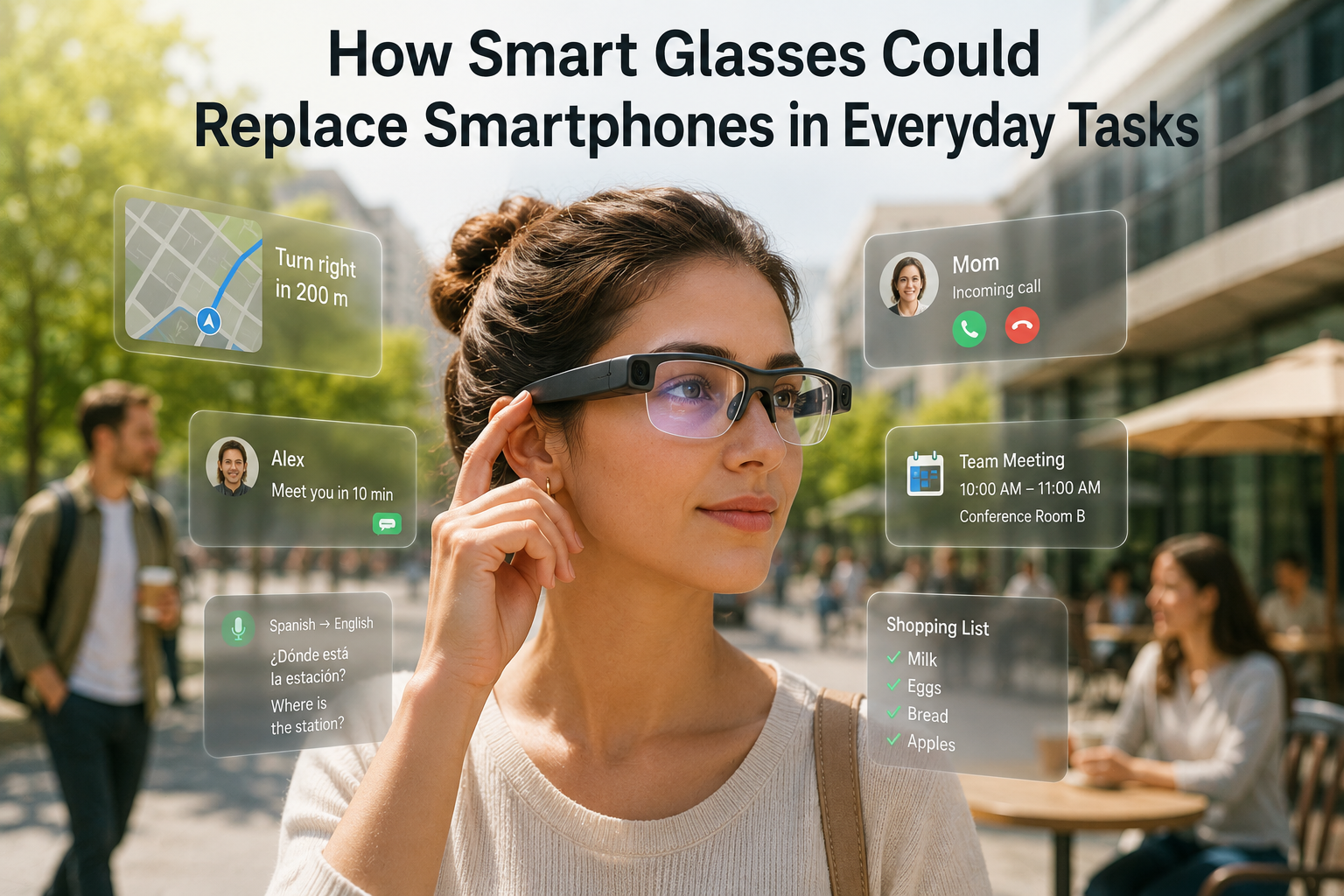
Smart glasses add hands-free digital features to eyewear frames, such as audio, cameras and sensors. They may even display a small heads-up display. Current smart glasses depend on smartphones for processing power, cellular connectivity, and apps; future versions will reduce this dependency by using on-device artificial intelligence systems to manage notifications, navigation, and quick tasks, while smartphones will handle heavy computation and secure connections.
1. Texting
Instant messaging and texting are popular communication tools used by many. Smart glasses would make an ideal companion for these activities, as they display information directly in front of the wearer without needing to open an app or look at your phone screen.
Smart glasses like the Xreal One Pro and Halliday wearable are lighter than traditional AR models, using direct projection instead of curved prisms to produce virtual images, creating a smaller device with lower power requirements.
2. Driving
New smart glasses are lightweight and fashionable. The Meta Orion displays screens and messages floating before your eyes, while the Xreal Air 2 and Rokid Max models look like regular eyeglasses while offering voice commands, music streaming capabilities, a camera lens and camera functionality.
Advanced microdisplay hardware, improved optics, and stronger on-device AI make today’s glasses work alongside you rather than replacing your phone. Improved gesture and voice recognition; always-on displays to eliminate constant device checks; hands-free media navigation and communication support productivity while decreasing stress. Still, a phone replacement must pass some major tests: people won’t swap out an essential gadget without an equally attractive alternative in its place.
3. Navigation
Smart glasses may help to reduce smartphone dependency with hands-free navigation and other features; however, most models still rely on phones for setup, notifications, connectivity, and application handoff. Advancements in artificial intelligence could one day lessen this dependency.
Smart glasses with heads-up navigation capabilities display information directly in the field of vision of their wearers, eliminating downward neck posture and attention splits that threaten safety when walking, cycling or driving. Furthermore, some models even allow voice or gesture control for additional convenience. Smart glasses with language support can assist visitors travelling to unfamiliar countries in understanding signs and menus, as well as offering definitions or summaries of new topics or concepts.
4. Video Calling
Smart glasses could become the next evolution in smartphone use, providing discreet displays with apps similar to those found on smartphones and allowing for more private use.
Consumer adoption of smart glasses relies heavily on practical performance, style acceptance, and enterprise validation. Currently, smart eyewear works with smartphones instead of replacing them, providing notifications and navigation while phones handle heavy processing and apps; however, on-device AI could reduce this reliance in the future. Halliday can provide assistance if you find yourself in an unfamiliar city and don’t speak the local language; she will translate signage for you immediately before your eyes.
5. Video Chat
Smart glasses with generative AI are more than just display devices; they bring people together to collaborate on solving problems, making decisions, and communicating. Video chat provides customers with face-to-face service and detailed product demonstrations, which is why Casey’s Furniture utilises Talkative as its virtual shopping consultation solution.
But, despite these advances, smart glasses will probably never replace smartphones in everyday tasks for most people anytime soon. Their long-term potential depends on meeting milestones for input, display comfort and resolution, battery and heat consumption, and privacy/social acceptance/price. In the meantime, smart glasses will serve as complementary products alongside smartphones for notifications, navigation or quick tasks such as scheduling an appointment.
6. Multitasking
People often believe they can multitask, but research demonstrates otherwise. What appears as multitasking is actually rapid task switching, which drains working memory and increases mistakes. Each time you shift between tasks, momentum is lost. Each interruption requires mental effort to regain focus after it has been interrupted and even half a second of distraction has been proved to lead to errors, according to research.
Smart glasses help multitaskers maximise productivity by keeping foreground and background tasks separate without interfering with each other. Furthermore, these glasses present valuable information directly in front of your eyes.
7. Eating
Some smart glasses feature a tiny projector and lens to display a virtual screen for quick information needs without looking down at a phone, such as restaurant menus or stock tickers during live TV interviews. These devices may be useful for tasks that require quick updates without looking down at a phone, such as restaurant menus or ticker updates during interviews.
Other smart glasses feature built-in speakers for listening to music or podcasts while wearing them; others provide cameras capable of taking photos or videos from a first-person perspective, though most rely on being connected with smartphones for processing power, cell connectivity and app ecosystem support.
8. Health Monitoring
Smart glasses, for instance, can detect when your heartbeat is too rapid or your blood pressure is elevated and alert you accordingly so you can take better care. Smart glasses equipped with audio tech — like Samsung’s earbud-style frames or the Android XR model from XReal — work similarly to headphones in that they contain microphones for making calls, listening to music, using voice assistants and taking photos and video-capturing capabilities. In some models they even include blue light filtering to reduce eye strain.
Smart glasses will become viable phone alternatives for most people depending on whether or not they can complete all the jobs that phones do well – particularly those requiring dense input, high trust or larger private screens. That framework matters far more than when specific smart glasses will first hit the stores.
9. Learning
Augmented reality (AR) smart glasses allow digital information to augment real-world views. Furthermore, these glasses may connect to 5G networks to offload data processing from smartphones and facilitate tasks like telemedicine consultations. Smart glasses also offer improved health monitoring and activity recommendations, providing personalised workout recommendations based on heart rate, movement and other indicators of health.
Smart glasses containing artificial intelligence (AI) may still be in their early days of development, but they’re already changing how we create and connect: helping athletes push beyond their boundaries, keeping parents from reaching for their phones when parenting young children, and providing creators quick prompts.