
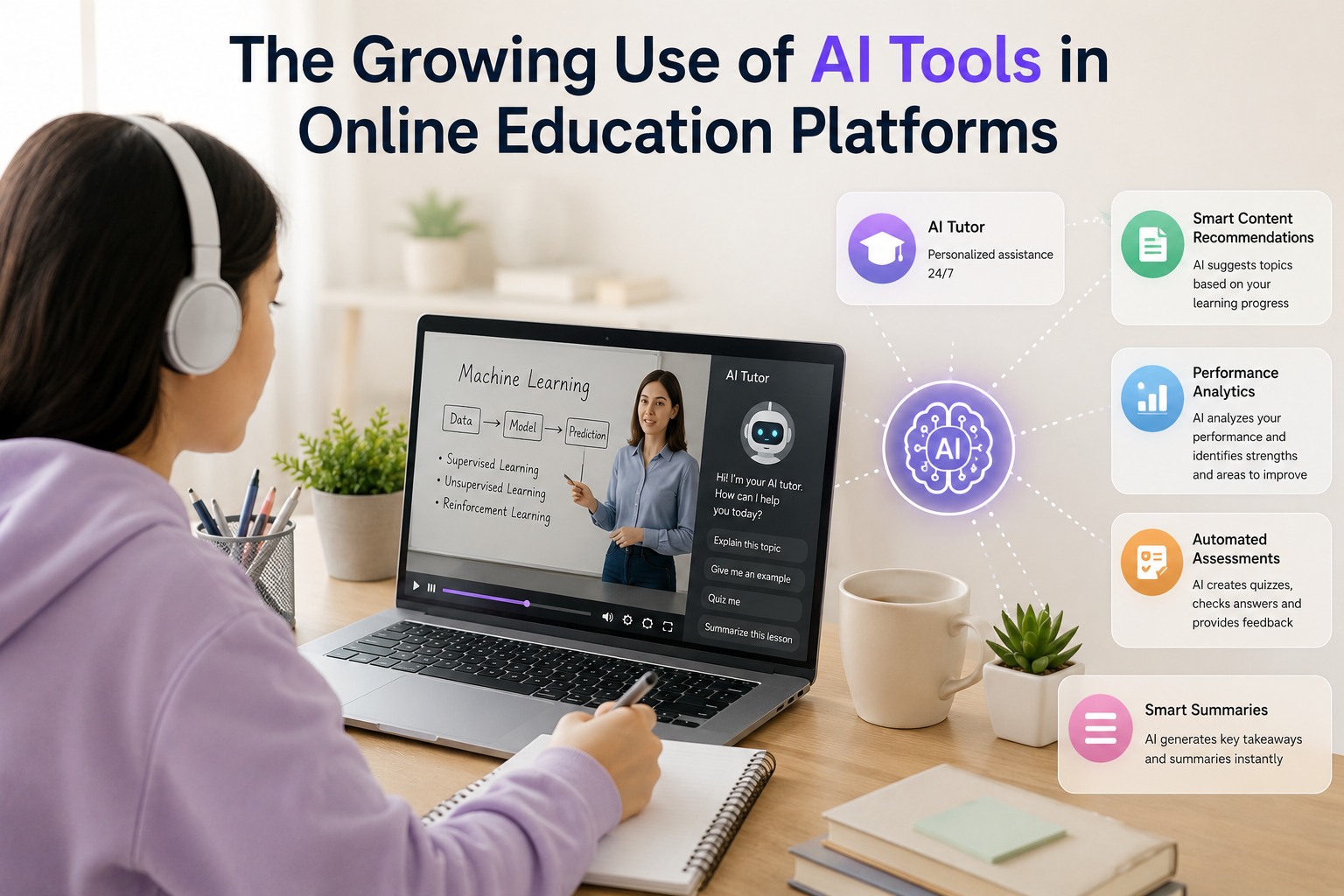
Over the past decade, a revolutionary transformation has taken place in digital learning environments, moving from passive video lectures and standardised tests to highly dynamic, interactive ecosystems. Artificial intelligence (AI) is the invisible engine behind this transformation in modern educational technology. AI technologies can analyse vast amounts of data in real time, allowing platforms to respond to the specific needs of students rather than forcing them to follow fixed curricula.
The application of AI in digital learning platforms has fundamentally changed the relationship between students, teachers, and course material. These platforms are no longer merely repositories of information but active participants in the learning process. They observe student engagement, anticipate potential problems, and provide support where necessary. This shift improves the quality of education and delivers high-quality learning experiences worldwide without increasing the administrative burden for teachers.
Personalized Learning Experiences
Traditional teaching methods often encounter problems because students learn at different paces and have varying levels of prior knowledge. AI addresses this challenge by generating highly personalised learning paths for every user on the platform. Machine learning algorithms continuously analyse student interactions and record what they grasp quickly and where they encounter difficulties or hesitation. With this continuous data stream, the system automatically adjusts the difficulty level, pace, and sequence of future lessons.
This adaptive approach means that more gifted students can proceed with more challenging material, while students who need more support are provided access to additional learning resources before moving on. AI-driven educational technology tailors learning paths to the specific cognitive characteristics of each user, minimising frustration and maximising learning efficiency. Students effectively benefit from a one-on-one guidance experience, while the software significantly improves overall pass rates and mastery of the material.
Automated Assessment and Feedback
Grading assignments and providing feedback takes up many teachers’ time and often slows down students’ learning process after they make mistakes. Nowadays, AI systems can grade daily assignments with astonishing speed and accuracy, quickly providing scores for multiple-choice questions, fill-in-the-blank questions, and even complex programming projects. Advanced natural language processing models can also be used to further evaluate short passages, checking grammatical correctness, thematic coherence, and the proper use of the required vocabulary.
Immediate feedback is crucial during the learning process because it offers students the opportunity to clarify any misunderstandings while the knowledge is still fresh in their memory. By outsourcing these time-consuming assessment tasks to programmes, teachers save valuable time. This time can be spent on more important tasks, such as guiding students, designing unique lesson plans, and leading class discussions characterised by human engagement and in-depth understanding.
Intelligent Content Creation and Selection
Creating engaging and up-to-date teaching materials is an ongoing process, especially in rapidly evolving fields such as technology. Artificial intelligence (AI) tools help curriculum developers automatically generate quizzes, flashcards, and supplementary literature based on the core subject matter. These technologies can scan textbooks or recorded lectures and quickly deliver a range of learning resources that highlight key points, saving educational designers significant time.
Furthermore, AI excels in content selection, similar to a streaming service’s recommendation engine. As courses progress, the system can import relevant and current articles, videos, and research reports from the web to enrich the course’s core content. This guarantees the currency and relevance of the course content, ensuring students always have access to the most recent information in their field.
Improved Accessibility and Inclusivity
Digital learning environments must serve a diverse international student population, including students with physical disabilities, learning difficulties, and varying language proficiency. AI has a significant impact on platform accessibility, such as real-time subtitling, automatic translation, and accurate text-to-speech functionality. Students with reading difficulties can listen to texts read aloud, while non-native speakers have access to live transcripts of lectures.
These innovations dismantle traditional barriers and create a fairer educational environment. For students with diverse neurological backgrounds, AI interfaces can adapt screen layout and text formatting to the user’s preferences, thereby reducing digital distractions. By integrating these intelligent support features into the core of learning platforms, educational institutions can create an environment where all students, regardless of their physical or linguistic abilities, have an equal chance to succeed.
Data-driven Educational Insights
Online learning platforms generate vast amounts of behavioural data with every user interaction. This data is subsequently collected and analysed by AI technologies, providing teachers with a comprehensive dashboard showing classroom trends and individual student learning outcomes. This means that teachers can immediately see which modules are likely to confuse students and adjust their teaching methods in real time. One of the most powerful applications of this data is predictive analytics. AI models can identify early warning signs that students are at risk of failure or dropping out, such as reduced login frequency or a sharp decline in test results. These predictive insights enable teachers and academic counsellors to intervene before students get stuck by offering targeted support and resources.
Challenges and Ethical Issues
The rapid adoption of artificial intelligence (AI) in education has yielded enormous benefits but has also brought with it serious ethical and operational challenges. Data privacy remains a major concern, as these platforms collect highly sensitive information regarding students’ learning habits, cognitive skills, and behavioural patterns. Institutions must implement strict security processes and transparent data management policies to prevent misuse or the leakage of sensitive student information.
Algorithmic bias and issues surrounding academic integrity also require careful attention. If the training data for educational AI models contains historical biases, the resulting systems may unfairly favour certain groups and disadvantage others. Moreover, the rise of generative AI technologies has offered students a way to bypass the learning process, for example by automating essays and assignments. For teachers, an ongoing challenge is designing tests that assess critical thinking and original analytical skills (rather than merely testing the memorisation of the subject matter).
The Future of AI in Online Education
The next chapter in educational technology will encompass the broader application of artificial intelligence (AI), extending beyond screen interaction and into immersive learning environments. AI will create realistic simulations for healthcare, technology, and vocational training on augmented reality and virtual reality platforms. Students will perform complex tasks in safe, responsive digital environments that react to their actions and errors.
Lifelong learning platforms will also deploy AI to plan complete career development pathways. These technologies will analyse current labour market trends, identify skill gaps in users’ resumes, and automatically generate a series of courses to help them further develop or start a new career. As AI continues to evolve, the boundaries between formal education and lifelong career development will blur, leading to a highly dynamic, always-available learning environment.
Welcome to a New Era of Digital Learning
AI is undoubtedly transforming online education, offering unprecedented personalisation, efficiency, and accessibility for learners worldwide. Although educational institutions must carefully consider ethical and privacy issues, their potential to improve student learning outcomes and support teachers should not be ignored. Educational institutions must deploy these tools strategically to remain competitive and effective. To remain competitive in this constantly changing environment, teachers and platform developers must prioritise transparency in their data processing and regularly upgrade their technological frameworks to foster inclusive, student-centred learning.
FAQs
1. What are the biggest benefits of using artificial intelligence in online education?
The main benefit is the ability to offer personalised learning experiences at scale. AI can assess each student’s performance in real time and adjust the difficulty and pace of lessons to optimise each student’s comprehension and retention.
2. How can AI help teachers?
AI can handle administrative and repetitive tasks, such as grading multiple-choice questions, creating quizzes, and tracking attendance. This allows teachers to focus on higher-level instruction, problem-solving, and providing emotional support to students.
3. Can AI tools help students with disabilities?
AI significantly improves the accessibility of educational resources through features such as real-time subtitling, accurate text-to-speech capabilities, and interface customisations. These tools enable students with visual, auditory, or cognitive impairments to fully follow the course material.
4. What privacy risks are associated with AI in education?
Because AI systems require large amounts of user data to function properly, there is a risk that sensitive student information may leak. Educational institutions must ensure they use secure and reliable systems and establish strict data privacy rules to prevent unauthorised access to or misuse of behavioural data.
5. Will AI replace human teachers in the future?
AI is designed to support human teachers, not to replace them. Algorithms can quickly deliver course material and perform routine tasks, but human teachers are crucial for fostering critical thinking, demonstrating empathy, and guiding complex conversations that algorithms cannot simulate.